


Imagine a medical student learning to operate using a virtual laparoscope. The simulated environment reflects reality with maximum fidelity, so the student perceives the data and images just as they would in a real operation. During the operation, he encounters a complication and does not perform the procedure correctly. However, thanks to the simulation, he finds out exactly where he made a mistake and can repeat the performance. He repeats it until he perfects his skills. In the real world, such a learning process would not be possible, but thanks to the virtual patient, the student can learn from their own mistakes, without risk to the patient.
Such modern interactive teaching is offered by the Center for Simulator and Virtual Medicine of the Faculty of Medicine of Pavol Jozef Šafárik University (UPJŠ) in Košice. Since its inception in 2021, it has been the largest of its kind in Slovakia. On an area of more than 900 m2, there are 24 rooms and more than 30 simulators. Its latest addition is the Simbionix ENDO Mentor Suite simulator, the purchase of which was also contributed by the U. S. Steel Košice Foundation, in the amount of EUR 50,000.
The simulation platform is used primarily by the specializations of urology, gynecology and obstetrics, but it has applications in all surgical fields. Says the head of the Urology Clinic of UPJŠ FM and the L. Pasteur University Hospital in Košice, MUDr.:
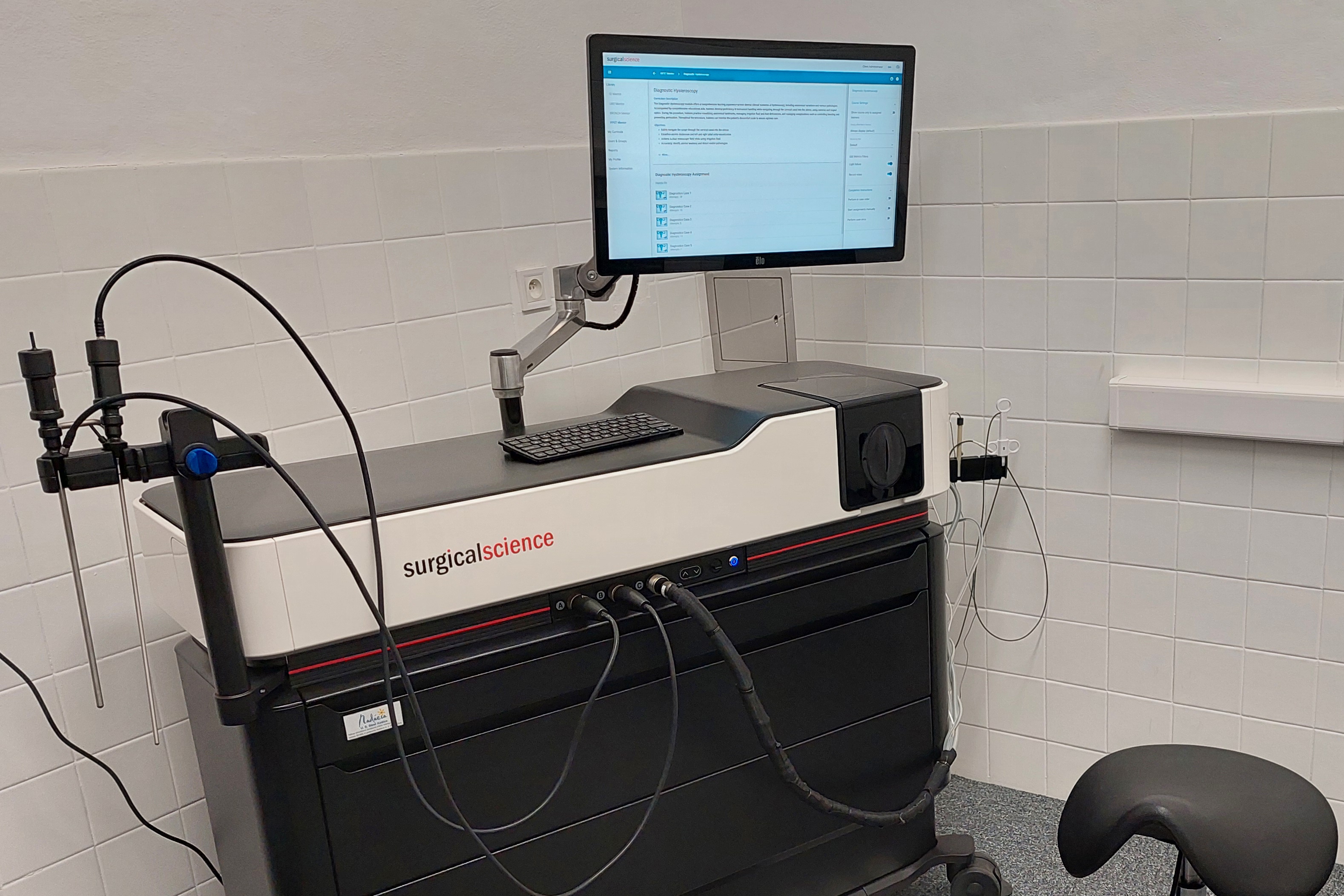
The advantages of practical training on simulators were added by the head of the Institute of Medical Informatics and Simulator Medicine of UPJŠ FM, under which the Center for Simulator and Virtual Medicine belongs, doc. Ing. Jaroslav Majerník, PhD.:
"The simulators provide a realistic and safe environment that allows students to hone their skills by repeating individual performances, practicing fine motor skills, as well as relieving stress. They learn to handle critical situations and complications in a controlled environment. They also have the opportunity to try out different approaches to solving clinical problems and see what will help the most in a given case. The advantage of medical simulators is, among other things, that they allow you to practice conditions and complications that are rare in real practice."


